
Bittensor Subnets vs Virtuals Agents
A breakdown of how Bittensor and Virtuals differ in capital formation, builder incentives, distribution, and where value accrues across infra vs applications.

Just a quick comparison between the two so you can get an understanding on the flywheel, the difference, and the similarities between the two.
Originally wanted to release this as a long post but found myself writing far too long for a long post.
Enjoy!
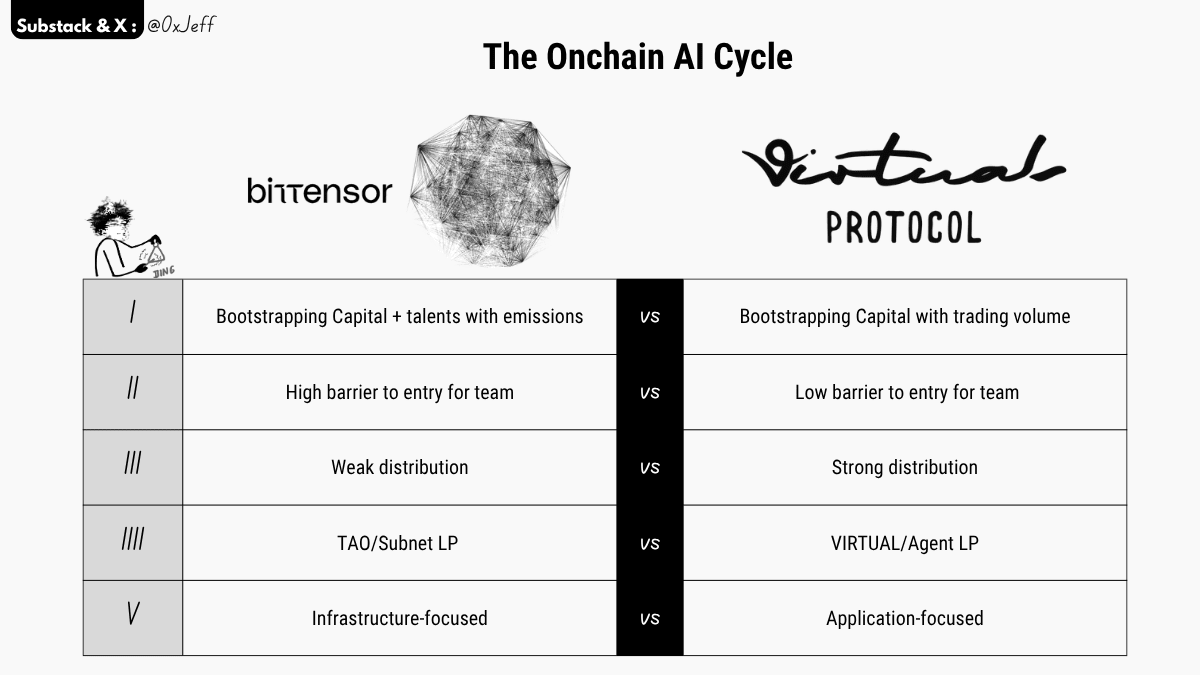
1. Bootstrapping capital & talents with emissions vs Bootstraping capital with trading volume
Bittensor = bootstraps subnets with TAO emissions. Subnets bring the best innovation (or revenue-generating business) + compete against each other for a daily share of 3,600 TAO
Subnets also bootstrap its contributors (miners who do work + validators who validate miners work) through alpha token emissions. Emission mechanism & coordination of incentives across stakeholders built in from Day 1
Virtuals = pumpfun model bootstrapping with trading volume. High trading activity translates to more capital accrued to agent projects. Agent teams can use their own emissions to incentivize activity.
This can be great during euphoria cycle where speculative demand on tokens is high — teams can bootstrap their capital quickly, gain mindshare + interest on their product, and kickstart their growth.
2. High barrier to entry vs Low barrier to entry (for team)
Launching a subnet on Bittensor is a major commitment. It takes 871 TAO (~$300k) for a subnet slot rn (price varies depends on demand/auction model). This usually means subnets team need to have a solid idea, a solid plan, and a solid execution.
In order to run a successful subnet, subnet owners need to make sure they create a task/objective that makes sense for the development of their AI product/solution + make sure miners can’t game it + make sure validators meaningfully validate miners + make sure they generate revenue by nailing the commercials/clients + make sure investors are happy with buybacks
Subnet token prices “need” to be up so that the subnet attracts more TAO, which increases the % emissions, which also increases the quality contributors looking to mine the subnet.
On Virtuals, it’s fairly easy to launch an AI agent token. No cost required to get started. This makes it easy to get started on new ideas with minimal capital.
Virtuals also has a 60-Day initiative where founders can test new ideas + launch a new token. If the idea could not find PMF within 60 days, the fund can be clawed back, allowing investors to claim some of the capital invested.
3. Weak distribution vs Strong distribution
Bittensor is isolated in its own chain, built using Polkadot Substrate framework. It’s very hard to bridge to, there’s no DeFi primitives, no key infra that we’re used to like EVM or Solana.
This makes it very hard to access Bittensor ecosystem. On top of this, a lot of materials are filled with complex jargons, making it hard for newcomers to learn, understand, and access Bittensor. Which is why most of the community are nerds who are willing to spend time to read & understand what TAO & subnets are all about. There isn’t much retail around.
On the other hand, Virtuals is very easy to understand. The team is great at marketing, storytelling, and distribution. Retail can easily grasp the concept of AI agents, agentic payments, robotics.
AI Agent tokens can be easily bought since Virtuals is on Base. The time to understand a project + get bullish on it + make a decision to buy the token is very short which practically propelled its popularity at the end of 2024 & 2025 (earlier than Bittensor)
Good thing about Bittensor now is that Jason, Chamath, Barry Silbert (DCG & Yuma) along with the community — have pushed Bittensor mainstream so the attention is there. But, the problem remains unchanged, it’s still very hard to buy subnet tokens.
4. TAO/Subnet LP vs VIRTUAL/Agent LP
Key similarity for both Bittensor & Virtuals is on the LP flywheel.
In order to buy subnet alpha tokens, an investor needs to have TAO to buy it. So, every time there’s demand for alpha tokens, TAO price go up.
Same thing with Virtuals, every time there’s demand for AI agent tokens, VIRTUAL price go up.
This set up is especially great if the key token (TAO or VIRTUAL) can be kept within the system without leaving (i.e. one team transacts goods & services with the other, keeping value within the network)
5. Infrastructure-focused vs Application-focused
Bittensor subnets often focus on infrastructure or CAPEX-intensive business (e.g. decentralized compute, inference, training, drug discovery, quantum experimentation).
Since Bittensor can help bootstrap >$10M per year to top subnets + attract top talents to contribute, this makes it a perfect model to kickstart ambitious ideas.
Virtuals agent teams often focus on application layer & consumer agents. Since agent token prices often start low, if an agent team has a really good consumer product, they can leverage the hype from token to attract mindshare & kickstart their growth.
The flywheel for ai agent tokens can often move much faster & much higher during peak euphoria (as seen from end of 2024 & early 2025) thanks to Virtuals distribution.
Disclaimer:
Each has their own strengths and focus on different things. Both can actually work together to expand Crypto AI thesis to the broader tech scene.
What I particularly like about
> Bittensor is the concept of Darwinian AI. The natural selection that pushes the pace of innovation + allows anyone to be a part of it
> Virtuals is how good they’re with storytelling & distribution + their focus on agentic commerce faster than anybody else (as seen from their x402 traction)
Thanks for checking out the article, if you have any feedback or questions, feel free to drop them below
Want to Continue Reading?
Check out the articles below (if you haven’t yet)
Disclaimer: This article is provided solely for informational and educational purposes and may not be redistributed, reproduced, or modified. The insights presented reflect our own research and judgment and should not be interpreted as endorsements or recommendations. Nothing in this article constitutes financial, investment, or professional advice. Market conditions are inherently uncertain, and asset values can fluctuate significantly including the possibility that an investment may decline substantially or even lose its entire value. All investments involve risk. Any financial decisions you make after reading this article are entirely your own, and we do not accept liability for any losses or results that may follow. Readers should conduct their own independent research before making any financial decisions.
If you’re having any trouble with email delivery, payments, cancellations, un-subscriptions, or refunds, the best first stop is the Substack Help Center for Subscribers or Substack Support as they are great at sorting out those issues.
If your concern isn’t fully resolved or you need additional help regarding your subscription, we are here for you. Just reply to this email (if you’re reading it in your inbox) or send us a message through our Substack page.
Getting in touch with us helps ensure any issue is addressed promptly and that your access to our future activities and community channels continues smoothly.
How does Near's agentic ecosystem compare?