
Most Decentralized Inference Players will FAIL due to a TRUST Problem
Decentralized Inference became the hottest Crypto AI narrative. What most people don't know is that most players will FAIL because they're repeating the mistakes that the past players made

There’s no denying that inference is one of the fastest growing sector in the entire world.
Weekly usage of models on OpenRouter increased from 3.2T tokens to 73.2T, almost 23x increase in a single year (this is just a single data point).
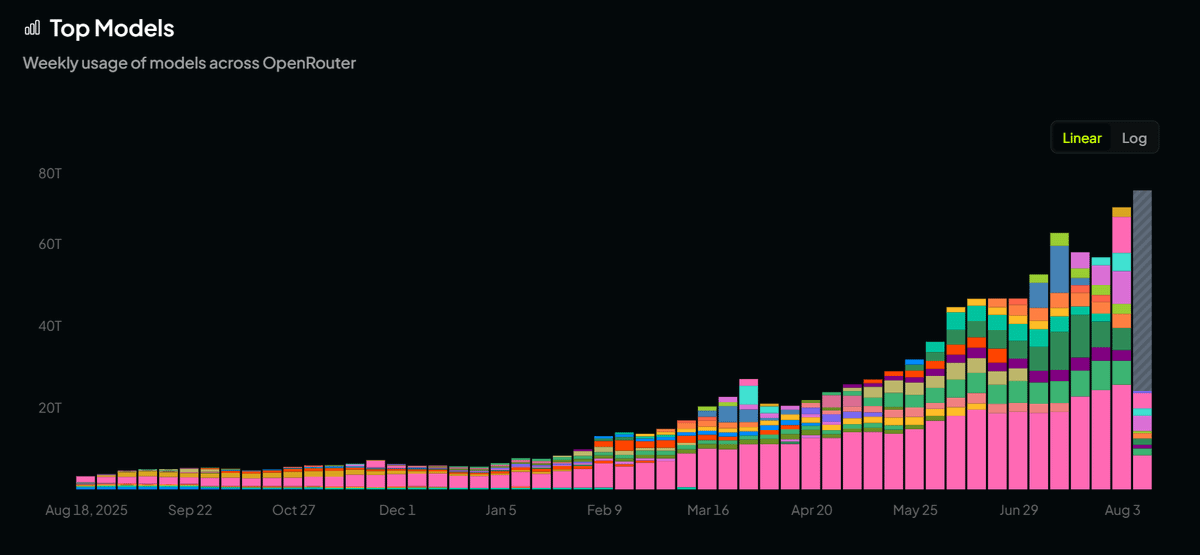
OpenRouter became the #1 inference gateway thanks to the team early-mover advantage + the core focus in making the routing fast, smooth, and reliable across any models imaginable. They raised at $1.3B valuation in May and are now in talks with Stripe for a $10B acquisition valuation.
We’re also seeing wave of inference providers raising billions of dollars this year to expand capacity and handle bigger AI workloads (Baseten, TogetherAI, Fireworks, DeepInfra, and many more).
While these players are scaling to handle big workloads especially from enterprises AI demand, a small yet significant sector remains undertapped.
Decentralized Inference.
Millions of consumer GPUs, Apple Silicon, and unused GPU sitting idle across the world.
Why not utilize their unused capacity and earn money from the growing AI workloads?
Sounds Good on Paper But Extremely Difficult to do
Many have attempted to crowdsourced unused GPUs across the world before.
Interestingly, the 1st AI project that I invested in back in early 2024 was a decentralized inference project. There are 3 reasons why it failed, most of it can be boiled down to “trust & verification”
So, when I see 6-7+ Bittensor Subnets attempting to run a decentralized inference network + the community thinking this is the Bittensor PMF, I get skeptical very fast.
In this article, I’ll breakdown
The 3 reasons why that project failed
Why most of these subnets will be an inference farm
Who might have the biggest chance at making it (at scaling it into an actual business) and why
Let’s dig in ↓
The Reasons Why That Past Decentralized Project Failed
Disclaimer: First of all, the intention of using this as a reference is not to throw shade over them. The founder was actually the guy who got me into the Onchain AI and Decentralized AI in the first place. If I hadn’t met the guy nor invested in the project, I would not have that initial moment that ignited the Onchain AI fire in me.
Running a decentralized network itself is pretty crazy if you think about it.
You take 1 GPU + another GPU + another GPU of strangers
Then you try to create a stable network where you, me, and any other users can reliably use the network to run AI — run basic prompts, run agentic workflows, generate videos, audio
When models and harnesses continue to get better every day, people demand in AI continue to get more and more.
We used to just talk to AI prompt by prompt, now most AI chat interface has agents handling workloads in the background. Thus, consuming far more tokens per session.
Because of this, it becomes increasingly important to make sure that your decentralized inference network is battle-tested, reliable, fast, and more importantly “trustless & verifiable“.